Portheras Cove
The Salt PathPortheras Cove is a beach on the South West Coast Path where the walkers’ exposure to the coast becomes literal: an unstable cliffside, a cold night above the tideline, and a rising sea force them to rescue their tent and belongings. The episode also marks a turning point in how Moth describes his strength and pain. In the book’s opening frame, the cove appears at dawn after the ordeal; the later account fills in the approach, the camp, and the night the sea came in.
Setting and Approach
The path descends gradually to Portheras Cove, following a stream toward the beach. As the walkers’ clothes dry in the wind, a Border collie bounds across the rocks, followed by a woman whose long blond-grey hair reaches below her waist even when plaited. The cove is not an uncomplicated resting place: the cliffs behind the beach are shale and unstable, so the tent is pitched across the stream, well away from the cliff face and far above the tideline marked by seaweed and shells.
The walkers have learned the coast by moving through it. After weeks of ebbing and flowing tides, they believe they can judge when the water will turn, but that familiarity does not make the campsite safe. At night, the light from Pendeen Lighthouse sweeps rhythmically over the headland without reaching the beach. Oystercatchers arrive as the cold bites through the sand. The narrator wears all her own clothes and some of Moth’s; he is not cold, but she shivers into a sleep that lasts only a few hours.
The Tide and the Tent
The sea then rushes in with force, rising beyond the tideline instead of stopping where the walkers expect. Their Vango tent had been chosen because it could remain upright without tent pegs, but the night tests it in a different way: the incoming water hoists it into the air with the airbeds and sleeping bags still inside. The tent’s resilience matters, but the immediate action belongs to Moth. In his underpants, he runs up the beach carrying the tent above his head and keeps moving even as the salt water climbs knee-deep through the freshwater stream.
The cove’s danger makes the rescue more than a dramatic camping mishap. The walkers have to act in darkness and cold to keep their shelter and possessions from being swept away; Moth’s sustained effort becomes the episode’s decisive reversal, from exposure and helplessness to escape. The opening account compresses the aftermath into a vivid image of him running in a ripped pair of underpants he has worn for five days, holding the fully erected tent overhead. It calls the rescue a miracle and, in the same breath, as good as it gets.
A Measure of Change
After the rescue, Moth says that he feels stronger: he can put one foot in front of the other and trust where it will land, he is dropping things less often, and his shoulder hurts less. He recalls that the pain became particularly bad after he stopped taking Pregabalin, but that somewhere before Newquay he noticed it easing; his head, too, feels clearer. He cannot tell whether the improvement is temporary or whether the symptoms will return when he stops walking. The scene does not resolve that uncertainty. Instead, the physical work at Portheras Cove gives his account of change immediate force: he has just carried the tent through rising water.
That experience stands against the doctors’ understanding of CBD as a one-way progression. The narrative does not claim that the disease has disappeared; it records Moth’s own perception of altered strength, pain, and clarity, and leaves open what will happen next. Portheras Cove therefore becomes a place where bodily evidence and medical expectation sit uneasily beside one another, without the uncertainty being explained away.
Dawn and the Journey’s Frame
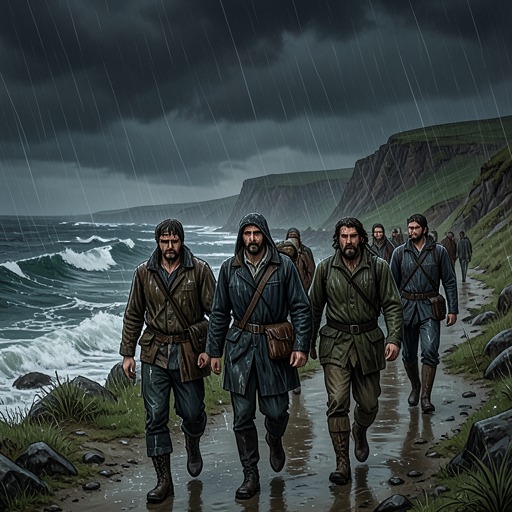
At first light, the walkers pack their rucksacks and make tea. The cove’s night of cold, rising water gives way to the routine that sustains the longer trek: another day on foot. The opening frame sets the scale of what has already been endured—243 miles walked, thirty-six wild nights, and dried rations for much of that time—against the guidebook’s expectation that the route would take eighteen days and offer comfortable beds, hot water, and good food. Those promised comforts have remained beyond reach. With 387 miles still to go, Portheras Cove is not a finish but a pause before movement resumes.
The book’s arrangement gives the place two related functions. The early glimpse shows the walkers already beyond the immediate crisis, making tea and setting out again; the fuller return to the cove reveals what that dawn has cost. Its significance lies in the contrast between the exposed beach and the simple act of continuing: a tent lifted by the sea, a cold night, a rescue, and then the packs going back on. Portheras Cove turns the coast from scenery into a force that tests the walkers, while their departure makes endurance a daily practice rather than a final victory.